Sustainability · the reuse case
Reuse first, recycle when reuse is done
An IBC tote is a durable, standardised container that usually outlives its first job by years. Putting it back into service avoids manufacturing a new one. Here is the case for reuse, stated plainly and without numbers we cannot back up.
Request a quote for reconditioned totes
Tell us the size, quantity and use. A partner supplier in our network follows up with a free, no-obligation quote.
The waste hierarchy, applied to one steel box
The hierarchy is familiar — reduce, reuse, recycle, recover, dispose. It is rarely applied to industrial packaging, because packaging is often invisible in procurement conversations.
Applied to an IBC tote, the hierarchy is unusually clear-cut.
Reduce
Before anything else: do you need the container at all? For high-volume users, bulk delivery into a fixed tank can remove the packaging entirely. For everyone else, reduction often means fewer, larger units — one 275 gallon tote in place of five 55 gallon drums.
Reuse
This is where most of the available benefit sits, and it is the rung most often skipped. A washed tote can do the same job as a new one for many duties. A rebottled tote gives you a new bottle while keeping the existing steel cage in service. Neither requires a new cage or a new mould cycle — only the decision to buy the reused one.
Recycle
Recycling is what you do when reuse is genuinely exhausted. It recovers the material and discards the object. HDPE and steel are both widely recyclable where facilities accept them, so the recovery can be good — but it is the fallback, not the goal.
Recover and dispose
Some small components, such as contaminated gaskets and mixed-material valve parts, can be hard to recycle. Ask the partner supplier handling your empties how each part is routed. See recycling and disposal.
Reuse versus recycling, side by side
The same tote, two end-of-life decisions.
Reuse it (wash and return to service)
- +Energy spent: washing, drying, inspection and handling.
- +Virgin material required: none, unless the bottle is replaced.
- +Object retained: yes — the engineering is preserved.
- +Effect: avoids manufacturing a new tote.
- +Time to return to service: typically short.
- +Value: a working container, priced by quote.
Recycle it (grind and melt)
- −Energy spent: granulating, washing, pelletising, re-melting.
- −Virgin material required: the next tote still needs to be made.
- −Object retained: no — the container ceases to exist.
- −Effect: recovers material, but a smaller benefit than reuse.
- −Time to become a product again: passes through several processes.
- −Value: scrap value of plastic and steel.
Questions people actually ask
Is reusing an IBC tote really better than recycling one?
Generally, yes. Reuse keeps the whole container in service and avoids manufacturing a new one. Recycling recovers the polymer and steel but discards the object, and the next container still has to be made.
Does reuse always make sense?
Not always. A tote with an unsuitable prior content, UV damage or a cracked bottle may not be fit for reuse, and very long freight distances can erode the benefit. A rebottled unit or recycling may then be the better route.
Can I get environmental figures for my reporting?
This site does not publish carbon or water figures. If you need documentation for reporting, ask the partner supplier who quotes your order what records they can provide.
Is HDPE from used totes safe to reuse?
For a suitable class of service, generally yes. HDPE is chemically stable and tends to fail through mechanical stress and UV, both of which are visible on inspection. The real constraint is content history, not material fatigue.
Answering common objections from procurement
"Reused packaging is a quality risk."
It is a supplier risk, which is different and manageable with a specification. Ask for written grades, leak-test records and documented prior contents. A supplier who provides those gives you something you can check.
"Our customers expect new packaging."
Some do, in specific sectors. Many have never been asked. Where it genuinely matters — retail-facing placement or audit requirements — buy new for those units and reconditioned for the rest. Applying the strictest requirement across a whole fleet is the expensive habit.
"The savings are not material at our scale."
Reconditioned totes are generally priced below new, and the difference scales with volume. Pricing is by quote from partner suppliers, so request a quote for both and compare.
"It will complicate our supply chain."
It can simplify it: empties stop being a disposal problem and become something a partner supplier collects or buys.
"We cannot verify the environmental claims."
Be wary of any packaging claim that comes with a precise number and no method. The qualified claim is the one that holds: reusing a tote avoids manufacturing a new one.
Sustainability questions from buyers
Does reuse conflict with recycled-content targets?
Sometimes, awkwardly. A reused container contains no recycled content because it contains no new material at all — which is generally better, but reports badly against a recycled-content target. If your targets are written that way, it is worth raising internally.
How do we account for reuse in Scope 3 reporting?
Purchased containers generally fall under purchased goods and services. Use emission factors appropriate to what you actually bought, follow your reporting framework’s guidance, and ask the supplier what documentation they can provide.
Is reuse better than recycled-content packaging?
Generally, yes. Recycled content still requires collection, granulating, washing, pelletising, moulding and transport. Reuse mainly requires a wash and an inspection.
What about the water used in washing?
Washing does use water and energy. Manufacturing a new bottle and cage also uses both, so for a tote fit for reuse, washing is generally the lighter option. Ask the supplier how their wash water is handled.
A packaging reuse plan you could start on Monday
Six steps, none of which need a capital budget or a consultant.
- 01
Count your containers
How many did you buy last year, of what, and what happened to the empties? Many companies cannot answer the third part, and that gap is where the opportunity is.
- 02
Split the fleet by duty
Which units touch product and which do not. Often only some of them genuinely need the strictest specification.
- 03
Change the default
Reconditioned becomes the standard catalogue line; new becomes the exception that needs a reason.
- 04
Stop paying to dispose of usable empties
Empties in good condition can often be sold rather than scrapped. Request a quote — see sell your totes.
- 05
Combine movements
Where possible, have the delivery that brings full or reconditioned totes take empties away. One trip instead of two.
- 06
Keep records
Track how many units you bought reconditioned, how many empties went back into service and how many were recycled. Ask suppliers what documentation they can provide.
More sustainability questions
Does the wash water cancel out the benefit?
Generally not. Washing uses water and energy, but manufacturing a new bottle and cage uses both as well. For a tote fit for reuse, washing is usually the lighter option.
What is the single biggest thing we could change?
Make reconditioned the default in your purchasing catalogue, with new as the exception. Much of the rest follows from that one decision.
Is every part of an IBC tote recyclable?
Be cautious of absolute claims. The HDPE bottle and steel cage are both recyclable where facilities accept them, but some small parts, such as gaskets and mixed-material valve components, can be harder to recycle.
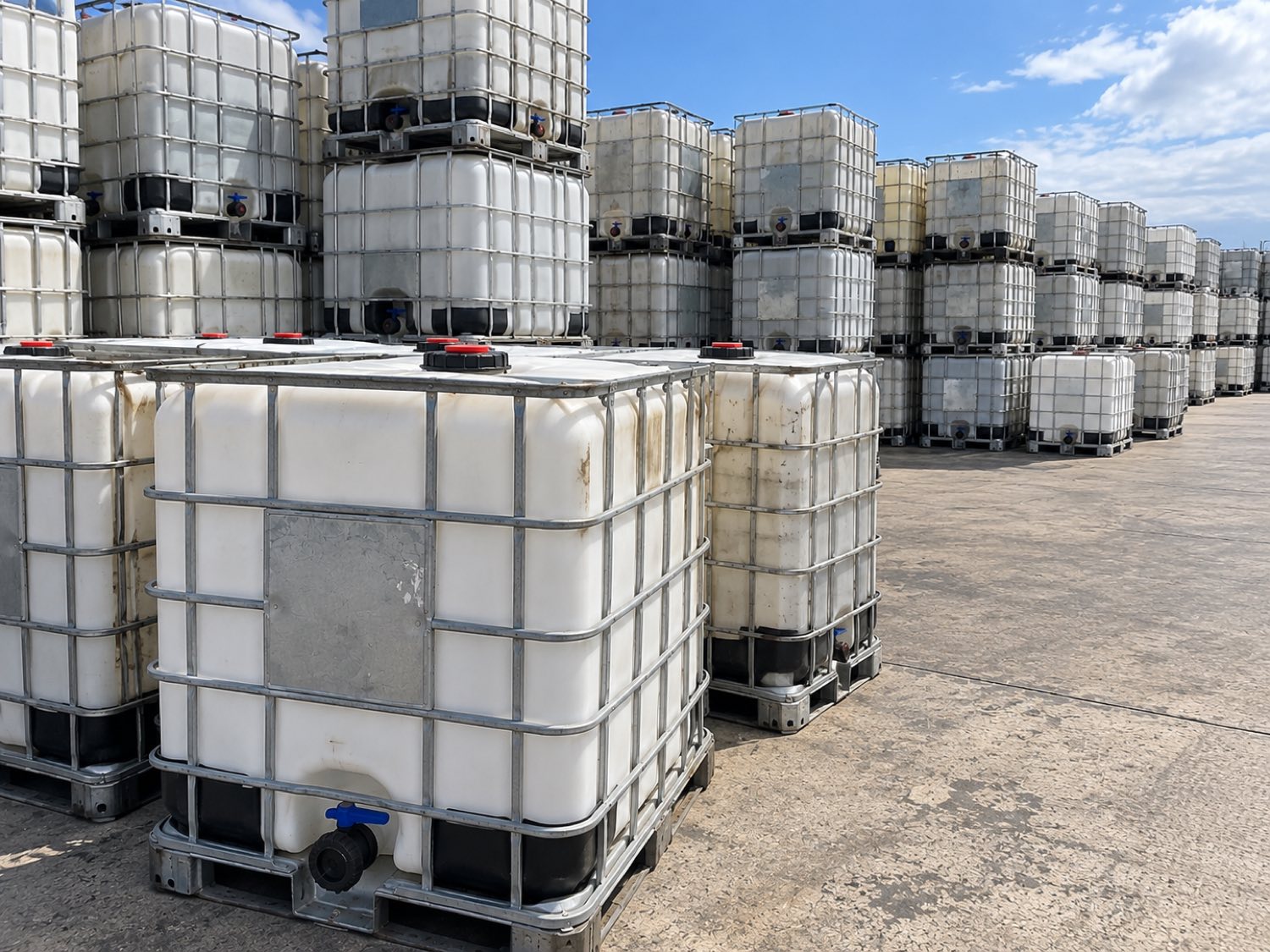
Totes waiting for another use
Where people go from here
Reuse first, then recycle.