Sizes & specs · master reference
The IBC tote size chart, with the numbers that decide a purchase
Capacity is the easy part. The numbers that actually decide a purchase are footprint, gross weight, clearance height and pallet type — so they are all on this page, and each one has a deep-dive article behind it.
Not sure which size fits?
Send a free, no-obligation quote request with your doorway width, ceiling height and the liquid. A partner supplier in our network follows up.
Master size chart
| Capacity | Litres | Footprint (in) | Height (in) | Typical empty (lb) | Water at full (lb) |
|---|---|---|---|---|---|
| 120 gal | 450 L | 40 × 32 | 42 | 70–90 | 1,001 |
| 180 gal | 680 L | 40 × 36 | 44 | 85–105 | 1,502 |
| 225 gal | 850 L | 48 × 40 | 40 | 100–125 | 1,878 |
| 275 gal | 1,000 L | 48 × 40 | 46 | 120–150 | 2,295 |
| 330 gal | 1,250 L | 48 × 40 | 53 | 140–175 | 2,754 |
| 350 gal (stainless) | 1,325 L | 48 × 42 | 52 | 350–420 | 2,921 |
| 450 gal (stainless) | 1,700 L | 48 × 46 | 58 | 420–500 | 3,755 |
| 550 gal | 2,080 L | 64 × 48 | 62 | 230–280 | 4,590 |
Nominal figures; add the tare to the water weight for gross. Builds vary by maker — often by up to an inch in height and two inches in footprint, and more on the less common sizes. If a rack pocket, elevator or doorway is within an inch of the limit, ask the supplier to confirm the actual lot — see dimensions and footprint.
The size matcher
Four sliders and a checkbox. It accounts for doorway width, ceiling height, specific gravity and food contact, then suggests a unit, the count and the gross weight to plan around.
275 gallon (1000 L)
1 unit per batch · 48" × 40" × 46" · approx 2423 lb gross
- Grade: Grade A or B technical, washed
- Pallet: composite or steel
- Watch out: gross weight is inside standard pallet-jack range
Deep dives by size
Each page carries dimensions in inches and millimetres, weights, pallet options, valve threads and what the size is genuinely good for.
- 01275 gallon (1000 L)The default. 48 × 40 × 46 in
- 02330 gallon (1250 L)Same footprint, 7 in taller
- 03120 & 180 gallonTight cells, small batches, lab duty
- 04550 gallon and upSteel skids, forklift-only handling
- 05Dimensions & footprintDoorways, racking, elevators, trailers
- 06Weight & capacity mathsSpecific gravity, gross weight, rack ratings
- 07Pallet & base typesWood, composite, plastic, steel
- 08Valve & cap threadsCommon threads and gaskets
- 09UN markings decoderRead 31HA1/Y character by character
Stacking and racking, in brief
- Stacking filled totes. The limit comes from the stacking load on the UN marking (in kilograms) and the manufacturer’s guidance. Divide the marked load by your gross weight per tote to see how many can sit on top of one.
- Racking. Two full 275 gallon totes of water on one beam level is about 4,840 lb. Racking is engineered per installation, so check the rating plate, not a rule of thumb.
- Damaged cages. Never stack a unit with bent or broken cage bars. A deformed cage transfers load unpredictably, and a collapsed stack of full totes is a genuinely dangerous failure.
The five measurements to take before you order
- Narrowest clear width on the route in. Doorways, aisle pinch points, gate posts. A 48 × 40 in tote needs 40 in of genuinely clear width leading with its narrow face — and a doorway with a door stop is narrower than its nominal size.
- Lowest clear height on the route in. Roller-shutter tracks, sprinkler heads, mezzanine undersides, trailer roof. A 330 gallon tote on a pallet jack is roughly 56 in to the top of the lid.
- Floor or rack load rating. A full 330 gallon tote of water is about 2,905 lb on a 13.3 sq ft footprint — about 218 lb per square foot. Mezzanines and older timber floors frequently cannot take that.
- Pallet jack or forklift access. Check which sides of the base accept a pallet jack. Steel skids on 550 gallon units are forklift-only.
- Dispensing height you actually need. Gravity feed into a 20-litre drum needs the valve above the drum lip. That usually means a stand, which raises everything above it.
Questions people actually ask
What are the dimensions of a 275 gallon IBC tote?
Nominally 48 in long × 40 in wide × 46 in tall (metric builds are 1,200 × 1,000 mm), typically weighing 120–150 lb empty and about 2,420 lb gross with water.
Is a 330 gallon tote the same footprint as a 275?
Yes — both are 48 × 40 in. The 330 is about 7 in taller, which matters for double-stacking, doorway height and trailer loading rather than floor space.
How much does a full IBC tote weigh?
Multiply gallons by 8.345 lb for water, then by your specific gravity, and add the tare. A 275 gallon tote of 50% caustic soda at SG 1.53 grosses roughly 3,640 lb — see weight and capacity.
Can IBC totes be stacked?
Sound, stackable designs can be, within the stacking load shown on the UN marking and the maker’s guidance. Never stack damaged cages.
What size valve is on an IBC tote?
Usually 2 inch. North American valves are commonly 2 in NPS; European-built valves often use the coarse S60x6 thread. Detail on the thread decoder.
Metric conversion sheet, for anyone working in both systems
Half of this industry specifies in litres and millimetres and the other half in gallons and inches. This is the bridge.
| Quantity | Imperial | Metric | Conversion |
|---|---|---|---|
| Capacity, standard tote | 275 US gal | 1,041 L (sold as 1,000 L) | × 3.785 |
| Capacity, tall tote | 330 US gal | 1,249 L (sold as 1,250 L) | × 3.785 |
| US gallon to imperial gallon | 1 US gal | 0.833 imp gal | × 0.833 |
| Footprint | 48 × 40 in | 1,219 × 1,016 mm | × 25.4 |
| Nominal height, 275 | 46 in | 1,168 mm | × 25.4 |
| Nominal height, 330 | 53 in | 1,346 mm | × 25.4 |
| Water weight | 8.345 lb/gal | 1.0 kg/L | — |
| Typical empty weight, 275 | 120–150 lb | 54–68 kg | × 0.4536 |
| Gross, 275 at SG 1.0 | ≈2,420 lb | ≈1,098 kg | × 0.4536 |
| Floor loading, 275 full of water | ≈182 lb/sq ft | ≈889 kg/m² | × 4.882 |
| Test pressure example | 36.3 psi | 250 kPa | × 6.895 |
| Discharge, 2 in | 2 in | 50 mm (DN50) | × 25.4 |
| Fill lid, 6 in | 6 in | 150 mm (DN150) | × 25.4 |
Why the 48 × 40 inch footprint constrains everything
Every dimension on this page is downstream of a decision made about pallets, not about liquids.
The 48 × 40 inch footprint matches the most common North American pallet, so totes move through the same racking, dock levellers, pallet jacks and trailers. A 275 gallon IBC is not 48 × 40 inches because that is the optimal shape for a thousand litres of liquid. It is 48 × 40 because that is the shape that moves through buildings.
The three consequences
1. Capacity grows upward, not outward. The 330 gallon tote is the 275 with seven extra inches of height, which is why it creates clearance problems rather than floor-space problems.
2. Gross weight grows faster than footprint. A full 330 of water loads a floor at about 218 lb per square foot against about 182 for a 275. Floor ratings are given per square foot, so the taller unit is disproportionately demanding.
3. Non-standard sizes are genuinely awkward. The 550 gallon at 64 × 48 inches overhangs standard bays and cannot be handled by a pallet jack. That is not a design flaw; it is the price of leaving the standard.
The practical rule
If a dimension in your building is within two inches of a tote dimension, measure it rather than assuming. The standard is a nominal, not a promise: builds vary by maker, and a doorway with a stop is narrower than its nominal width.
Dimension and capacity questions
Is a 275 gallon tote the same as a 1,000 litre tote?
Effectively, yes. 1,000 litres is about 264 US gallons, and the North American "275 gallon" name covers the same 1,000 litre class of design. The bottle holds somewhat more to the brim, which is headspace, not working capacity.
What is the smallest IBC tote available?
120 gallon (450 L) is the smallest common caged size, nominally 40 × 32 × 42 inches. Below that you are into drums and small poly tanks.
How tall is a tote on a pallet jack?
Add roughly three inches to the overall height. A 275 becomes about 49 inches and a 330 about 56, which is the number that matters for shutter doors.
Can I get a tote that fits through a 32 inch door?
A 120 gallon unit at 32 inches wide will pass a 36 inch door with a jack. Through a 32 inch door itself, nothing caged will fit — that is drum territory.
Why do manufacturers list different heights for the same capacity?
Because pallet type changes overall height, and because bottle designs differ in shoulder geometry. Always measure the actual lot if a clearance is tight.
Every size against every constraint, in one grid
If you know your binding constraint, read down that column. Nominal sizes; confirm the actual unit when a figure is tight.
| Constraint | 120 gal | 180 gal | 275 gal | 330 gal | 550 gal |
|---|---|---|---|---|---|
| 36 in doorway | Yes | No (36 in wide) | No | No | No |
| 48 in doorway | Yes | Yes | Yes | Yes | No |
| Under 50 in clear height on a jack | Yes | Yes | Tight | No | No |
| Under 60 in clear height on a jack | Yes | Yes | Yes | Yes | No |
| Pallet jack only | Yes | Yes | Yes | Yes | No |
| Mezzanine at 150 lb/sq ft, full of water | Yes | No | No | No | No |
| Goods lift, 2,000 lb, full of water | Yes | Yes | No | No | No |
| Double-stack empties in a dry van | Yes | Yes | Yes | Marginal | No |
| Batch size under 150 gal | Yes | Yes | Wasteful | Wasteful | No |
| Batch size 250–350 gal | No | No | Yes | Yes | No |
European versus North American sizing, for anyone buying across markets
If you operate on both sides of the Atlantic, the sizes look the same and are not quite.
The footprint
In North America the standard tote is usually quoted as 48 × 40 inches (1,219 × 1,016 mm), matching the common pallet footprint. In Europe it is quoted as 1,200 × 1,000 mm (47.2 × 39.4 inches). Many totes sold in North America are built to the metric size. The difference is under an inch on each axis — enough to matter in a tight rack pocket or automated handling.
The capacity
Both markets build to the 1,000 litre class. North America calls it 275 gallons (1,000 litres is about 264 US gallons). Europe calls it 1,000 L.
The threads
This is the one that bites. North American valves commonly have a 2 inch NPS outlet; European-built valves often use the coarse S60x6 thread. Forcing a fitting onto the wrong thread galls it and then leaks — use the right adapter.
Marking
UN markings follow the same international model, so a 31HA1 marking means the same thing in both markets. The country code differs, and national rules on testing and acceptance differ in detail — check current regulations.
The practical advice
Buy locally in each market where you can, standardise on fittings within each region, and label European-thread units in a mixed fleet so nobody wastes twenty minutes and a thread.
More sizing questions
Which size has the best used market?
275 gallon, by a wide margin. If availability matters more than capacity, that is usually the answer.
Can I mix sizes in one fleet?
Yes, and many do, but it complicates racking, washing schedules and spare parts. Where a mixed fleet exists, it is usually 275s for the bulk and a few 120s for the awkward spaces.
What is the most common mistake in size selection?
Choosing on capacity alone and discovering the height constraint afterwards. Height and weight, not floor area, are often the binding constraints in a building.
Are there totes bigger than 550 gallons?
An IBC is limited to 3,000 litres (about 793 gallons), and caged units above 550 gallons are rare. Past that, a fixed tank is usually worth comparing.
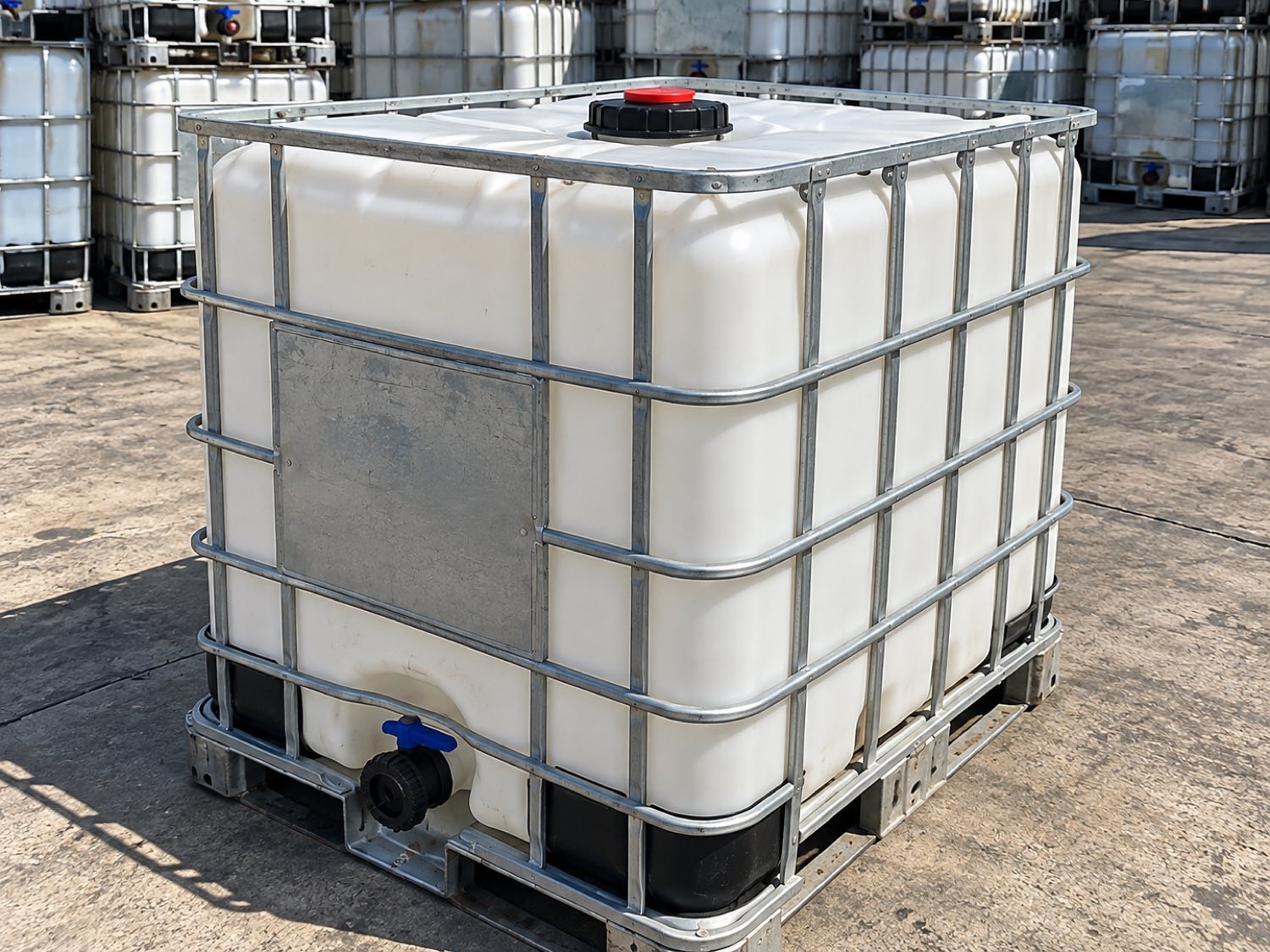
48 × 40 × 46 inches
Reuse first, then recycle.