Services · selling empties
Selling used IBC totes through partner suppliers
Empty totes often have resale value. Send a count, sizes, prior content and location, and the request goes to partner suppliers in our network who may buy used totes. Whether a supplier makes an offer, and on what terms, depends on the totes and on the supplier.
Ask partner suppliers about your empties
Quantity, sizes, last product and location help a partner supplier assess the totes. Put the last product in the message field.
What generally affects interest and value
| Factor | Generally helps | Generally hurts |
|---|---|---|
| Prior content | Documented food, beverage or water | Undocumented, unknown or hazardous |
| Bottle | Intact, no cracks or crazing | Cracked, crazed or holding cured residue |
| Valve and cap | Present and intact | Missing or broken |
| Heel | Fully drained | Liquid left in the bottle |
| Quantity | Many units in one place | One or two units |
| Access | Dock or forklift on site | No handling equipment |
Each partner supplier sets its own criteria. Pricing is by quote from partner suppliers.
Four things that move value more than you expect
1. Documentation, not cleanliness
A tote whose last product you can name in writing is generally worth more than an identical-looking tote you cannot, because documentation opens up more resale options. Find the fill record before you ask for an offer.
2. Quantity in one place
Freight is a large part of the cost of collection. A few totes on a residential driveway may be worth little once collection is paid for; a larger number on a loading dock is a different job. If you only have a few, neighbours in the same industrial park may have some too.
3. Whether the heel is drained
A tote with liquid left in it is a waste-handling job, not a container sale. Drain and collect the heels properly, following the product SDS, before collection.
4. The valve and the cap
A missing cap lets debris and insects in, and a missing valve means replacement hardware. Keep the caps and valves on the units.
How a selling request works
- 01
Send the details
Unit count, sizes, last products, location and access. Photos of the cage plate and the bottle interior help a buyer assess the totes.
- 02
The request goes to partner suppliers
We pass it to partner suppliers in our network who buy used totes.
- 03
A partner supplier follows up
If a supplier is interested, it sends its own offer, collection arrangements and payment terms.
- 04
Prepare the units
Drain heels, refit caps and group the totes somewhere a trailer can reach.
- 05
Collection
Collection is arranged by the partner supplier, sometimes on a trip that is already running your way.
If your totes are genuinely finished
Not every tote can be resold. Cracked bottles, failed tests and contaminated units go to recycling and disposal instead, which partner suppliers can also arrange. Pricing is by quote.
Questions people actually ask
How many totes do I need before it is worth collecting?
It depends on the partner supplier and the location. Generally, more units in one place are easier to collect; for a few totes, a supplier may suggest drop-off or combining with other sellers nearby.
Will partner suppliers buy totes that held hazardous chemicals?
Some may, if the content is documented and the residue is manageable. Some contents need a licensed waste route instead. Describe the last product accurately and check current regulations.
Will damaged totes be bought?
A damaged bottle in a sound cage can still interest a supplier that rebottles. See replacement parts.
Can I trade empties against a purchase?
Some partner suppliers can combine a delivery of totes with a pickup of empties. Mention both in your request.
What paperwork do I get?
That depends on the partner supplier. Ask what it provides, such as a bill of sale, before you agree to an offer.
Preparing totes for sale: the week before collection
Each of these can improve an offer, and none needs specialist equipment.
- 01
Find the fill records
A documented food, beverage or water history generally opens up more resale options than the same tote without one.
- 02
Drain the heels properly
Tilt toward the outlet, then pump out what remains through the top opening. Collect it into labelled containers and handle it according to the SDS — see how to sell used totes.
- 03
Refit every cap and dust plug
Missing caps let in debris, insects and rainwater, which lowers the value of the unit.
- 04
Group them somewhere a trailer can reach
Totes on a dock are a different job from totes scattered across a site. Access is one of the largest variables in an offer.
- 05
Photograph honestly
A cage plate, a bottle interior through the lid, and a wide shot showing access. Photograph a typical unit, not only the best one.
- 06
Ask your neighbours
Combining several sellers in one industrial park can turn several small pickups into one worthwhile stop.
- 07
Get the offer in writing
Per-unit price, collection arrangements and conditions, from the partner supplier, in writing.
Resale outlook by prior content
| Prior content | Resale outlook | Notes |
|---|---|---|
| Food, beverage, water, documented | Generally strongest | Opens up food-related reuse |
| Detergents, surfactants | Generally good | Usually wash well |
| Glycols, coolants | Generally good | Usually wash well |
| Mineral oils, lubricants | Fair to good | Generally need a caustic wash |
| Water treatment chemistry | Fair to good | Hypochlorite can stain |
| Fertilisers | Fair to good | Crystallisation is the main issue |
| Adhesives, resins, uncured | Moderate | Drain before it sets |
| Adhesives, cured in the bottle | Low | Bottle usually needs replacing |
| Documented solvents | Case by case | Needs a suitable wash process |
| Paints and coatings | Case by case | Depends on whether it has skinned |
| Pesticides, herbicides, biocides | Restricted | Generally excluded from food and edible-crop use |
| Isocyanates, peroxides, oxidisers | Usually not resold | Often needs a licensed waste route |
| Undocumented / unknown | Lowest | Generally limited to non-critical uses |
| Stainless IBCs, any content | Often of interest | Depends on alloy and condition |
Each partner supplier sets its own criteria. An unknown history closes off the most valuable resale routes, so if you can find the record, find it.
Selling questions
How quickly can totes be collected?
That depends on the partner supplier and the location. The supplier gives timing with its offer.
Will a supplier take a mixed load of totes and drums?
Some partner suppliers also take drums. Mention them in the request.
How is payment made?
Payment method and timing are set by the partner supplier and stated in its offer.
What if some units fail inspection after collection?
Ask the partner supplier how failed units are handled before you agree to an offer, and get the answer in writing.
Our name is on the labels. What happens to the totes?
Ask the partner supplier how labels are removed and whether retired units are rendered unusable. Agree it before collection.
Can I sell totes that still have product in them?
Not as containers. A tote with saleable product in it is an inventory question, and a tote with unknown liquid is a waste job. Drain first, then send a request.
What generally happens to used totes after resale
Because "sell your totes" tells you nothing about what happens next.
Used totes bought for resale are generally inspected, washed or rebottled, graded and sold on. See tote grades explained for how condition is usually described. Three things sellers often ask about:
Your branding
Labels are usually removed. If your product name is on the totes, ask the partner supplier how branding is handled and whether retired units are rendered unusable.
Your documentation
A documented content history generally makes a tote easier to place in its next use. Ask whether your company name is shared with the next buyer.
Units that fail
Totes that fail inspection generally go to recycling. Ask how failed units affect the offer before you agree to it.
More selling questions
Can we sell totes we lease from someone else?
No, and please check before offering them. Leased and pooled containers belong to their owner. If you are unsure, the plate or an asset tag usually says.
Do totes with another company’s branding still sell?
Generally yes. Labels are usually removed as a matter of course.
What if we want to sell some units and keep others?
Normal. Agree the split with the partner supplier before collection and mark the units that are staying.
Can the value go against a purchase?
Some partner suppliers can offset empties against a delivery of totes. Mention both in the request.
Used totes awaiting inspection
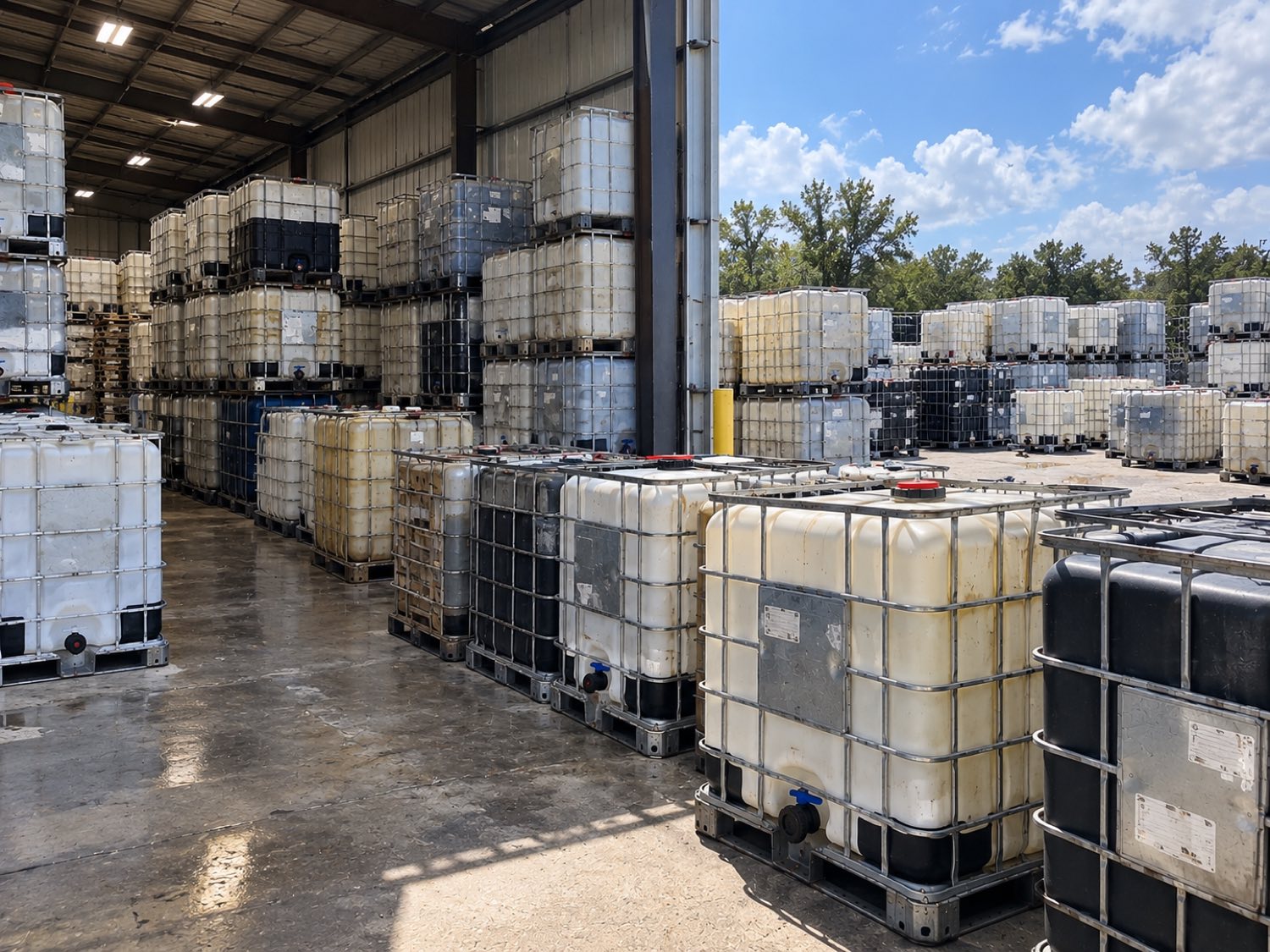
Reuse first, then recycle.