Services · reconditioning
IBC tote reconditioning and washing
Reconditioning is what makes a used tote fit for another job. Partner suppliers in our network offer washing and reconditioning; this page explains how the process generally works, so you know what to ask for.
Request reconditioning for your totes
Tell us the unit count, the last product and the next intended use.
Common reconditioning service levels
| Level | What it generally involves | Typically suited to |
|---|---|---|
| Rinse | Repeated water rinses, drain, cap | Water-soluble residues, sugars, brines |
| Hot wash | Hot water through a spray head, then drying | Light industrial residues, glycols, detergents |
| Caustic wash | Heated caustic solution with surfactant, rinse, drying | Oils, fats, adhesives, pigments |
| Valve service | Strip, inspect the seat, new gasket | Most reconditioned units |
| Cage repair | Straightening and weld repair of bent or broken bars | Cages with damage but a sound frame |
| Rebottle | New inner bottle in a reconditioned cage, new hardware | Food, potable or odour-sensitive uses |
| Leak test | Fill or pressurise, hold, inspect | Often included; confirm with the supplier |
What is included varies by supplier. Pricing is by quote from partner suppliers.
How reconditioning generally works
Good reconditioning is repeatable rather than clever.
A unit is first logged against its prior content, because that decides the method. Keeping food-candidate units physically separate from chemical-history units is good practice, and worth asking about if the totes are destined for food use.
Washing usually means a rotary spray head lowered through the top opening to reach the bottle wall and the underside of the lid. Fats, oils and adhesives generally need heat and a caustic solution rather than pressure alone. Wash water has to be handled according to local rules.
The unit is then dried, since a damp bottle can grow biofilm. The valve is serviced and a gasket is chosen for the *next* product, not the last one.
Finally the unit is inspected, often leak-tested, and graded. Units that fail go to recycling rather than back into service.
Reconditioning your own totes vs buying reconditioned ones
Recondition your own
- +Often the lower-cost route when your cages are sound.
- +You keep your own totes, colours, tags and any branding.
- +Suits closed-loop use where the same totes cycle between you and your customer.
- +Combining collection with a delivery can reduce freight.
Buy reconditioned totes instead
- −No wait while your own units are processed.
- −Better when your units are tired and would need rebottling anyway.
- −No return freight on units that might fail inspection.
- −Simpler when you need more totes than you own.
Questions people actually ask
Can my totes be made food-grade again?
Generally, if they only ever held edible products, washing plus testing may be enough. If they held anything else, a new bottle is usually the only way to restore a food-contact surface. Confirm documentation with the supplier and check current regulations.
How long does reconditioning take?
It depends on the partner supplier, the lot size and transport. The partner supplier gives timing with its quote.
Can I get a wash record?
Many reconditioners can provide one. Ask the partner supplier what its record includes before you agree to the work.
What about totes that held pesticides?
Generally, totes that held pesticides should not go into food, potable or edible-crop service. Follow the product label and check current regulations.
Common wash approaches by residue
General guidance on how reconditioners usually match the method to the residue.
| Residue class | Common approach |
|---|---|
| Sugars, syrups, molasses | Warm water rinses |
| Brines, salts | Water rinses |
| Surfactants, detergents | Water rinses with low agitation |
| Glycols | Water rinses |
| Edible oils, fats | Hot caustic wash |
| Mineral oils, lubricants | Hot caustic wash with degreaser |
| Pigmented concentrates | Extended hot rinse |
| Adhesives, uncured | Caustic wash with pre-soak |
| Acids, dilute | Neutralise, then rinse with pH checked |
| Caustics | Rinse to neutral with pH checked |
| Hypochlorite | Rinse and ventilate |
| Documented solvents | Dedicated closed process |
| Pesticides | Rinse as the product label directs |
| Unknown | Generally not washed for reuse; recycled instead |
General guidance only. Follow the product SDS and label, and the reconditioner’s own procedures.
What a useful wash record contains
Whether you wash totes in-house or ask a partner supplier, this is the record worth having.
A cleaning record is more than a tick in a logbook. A useful one has nine fields per unit.
- Unit identity — an asset number, so the record ties to a physical tote rather than a batch.
- Prior content — the specific product, not a category.
- Method — rinse, hot wash, caustic wash, dedicated process.
- Temperature — measured, not set-point.
- Duration — actual cycle time.
- Chemistry and concentration — what was used, and at what strength.
- Final rinse — potable or process water, stated explicitly.
- Verification — odour check, water-sample result, pH where relevant.
- Operator and date — who did it, and when.
The three fields people skip
Temperature, verification and operator. Without temperature a controlled process becomes a hopeful one. Without verification you cleaned but never checked. Without an operator nobody is accountable.
Wash water
Where it goes is a question to answer before starting. Rules on discharging rinse water vary, and caustic solutions generally need neutralising. Check local rules.
Reconditioning questions
Can totes be washed on our own site?
Some reconditioners work only from a fixed facility and some offer mobile washing. Mention on-site washing in your request.
Is there a minimum lot size?
Minimums vary by partner supplier. Larger lots of one prior content are generally simpler to process.
Will washing remove staining?
Usually not, and staining is often cosmetic. Some products stain HDPE permanently. If you need a visually clean bottle, that generally means a rebottle rather than a wash.
Can stainless IBCs be washed?
Yes, generally, and a tank with a spray ball can be cleaned in place. Stainless may also need passivation after heavy service; ask the partner supplier.
Can totes be washed to our own protocol?
Include the protocol in your request. The partner supplier can say whether it can follow it, and which steps it cannot.
Sending your own totes for reconditioning: the practical sequence
- 01
Say what was in them
The specific product, not a category. It decides the method and whether a reconditioner can take them at all.
- 02
Drain the heels
Pump out what remains through the top opening, not just through the valve. An undrained lot becomes a waste-handling job.
- 03
Count and photograph
Cage plates, a bottle interior and a wide shot. A partner supplier can flag units likely to fail before collection.
- 04
Agree the specification
Wash level, gasket material for the next product, pallet type, and any food-use handling and documentation.
- 05
Arrange transport
Ship the totes or ask the partner supplier to collect, ideally on a trip that is already running.
- 06
Inspection on arrival
Some units may fail. Ask for a report and photographs of anything that does.
- 07
Return with records
Ask for a wash record per unit and test results, as agreed with the partner supplier.
More reconditioning questions
Is the outside of the cage cleaned too?
Often, and it is worth asking. A dirty cage can hide corrosion during inspection.
What if a tote fails during washing?
It generally goes to recycling. Ask the partner supplier up front how failed units are charged and reported.
Can a lot with mixed prior contents be washed?
Generally yes, but the units are sorted by residue, which takes longer than a uniform lot. Describe the mix in your request.
Should I accept a wash certificate without a wash?
No. A cleaning record is only worth something if it describes a process that was actually performed.
Washed totes in storage
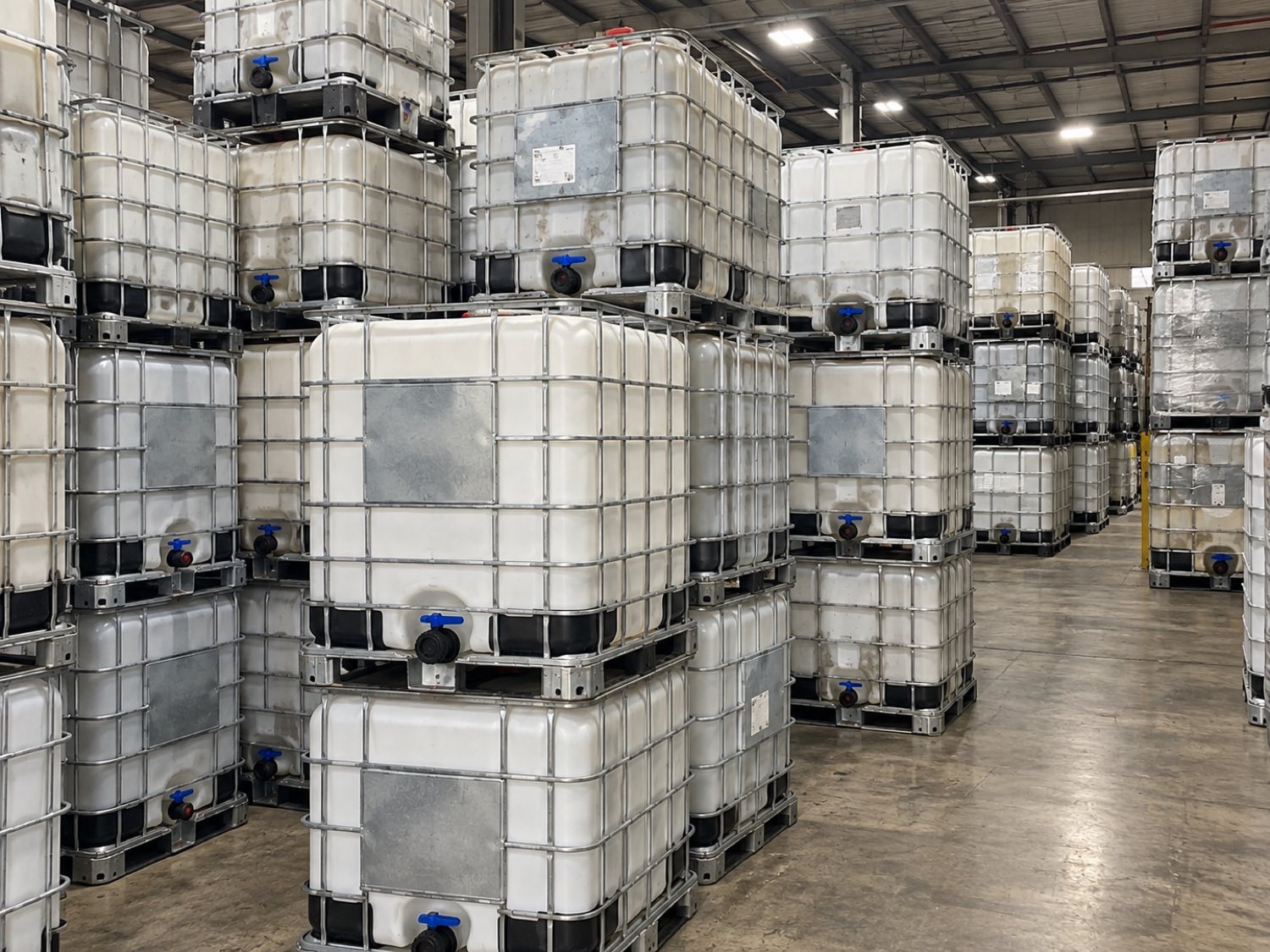
Reuse first, then recycle.