Products · rebottled
Rebottled totes: a new bottle inside steel that already exists
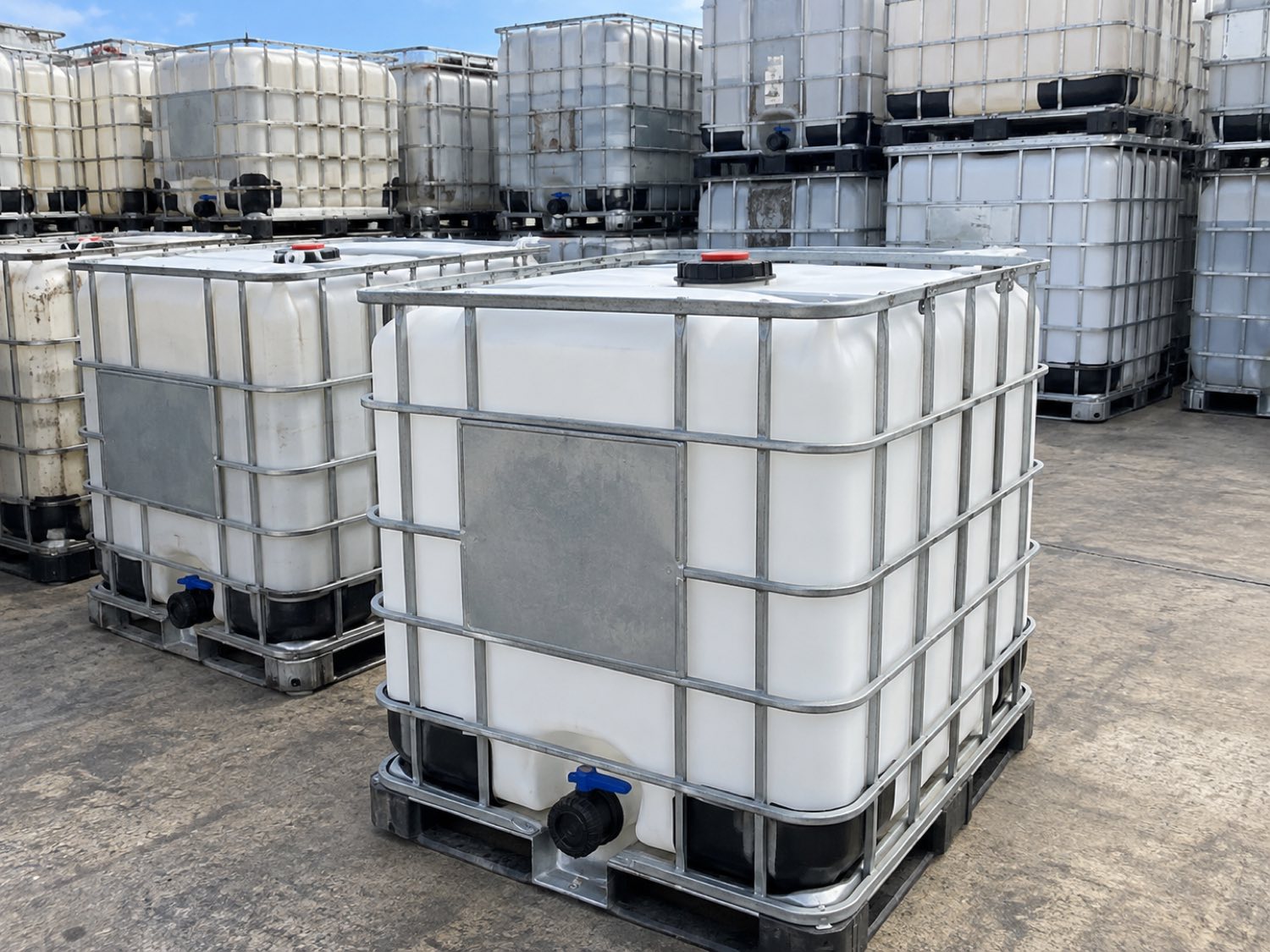
The bottle is the part that wears out and the part that touches your product. The cage is the heavier, longer-lived part. Rebottling replaces the first and reuses the second.
Request a rebottled tote quote
Tell us your product and quantity. A partner supplier follows up with availability and pricing.
Why the bottle is the part worth replacing
Break an IBC tote into its parts: an HDPE bottle, a welded steel cage that makes up most of the empty weight, and a wood, composite or steel pallet. In service, the steel is the half that rarely fails.
Cages get retired for cosmetics: a scuffed coating, a bent lower bar from a forklift, a missing label. The bottle is the component that absorbs everything your product does to it: permeation, staining, odour retention, UV crazing and stress whitening around the boss.
Rebottling accepts that asymmetry. The tired bottle goes to material recovery, the cage is straightened and inspected, a fresh bottle is fitted, and the valve is rebuilt to suit the chemistry. The interior is new where it matters.
What to expect
- A new, never-filled HDPE bottle with the moulder date stamp intact. Ask the supplier for its documentation.
- A reconditioned cage, straightened, with welds inspected.
- A choice of pallet: composite, plastic or steel are preferred for food and wash-down service.
- A new 2-inch outlet valve with the gasket material matched to your product, plus a vented or solid 6-inch lid.
- A leak test record, and a tamper-evident cap seal if you are shipping to customers.
Rebottled versus food-grade used
Both can be requested for food service. They are not the same purchase.
Rebottled (new bottle)
- +No prior contact: nothing has ever been in the bottle.
- +Avoids the content-history question in audits.
- +Consistent, bright bottle wall makes level checks easy.
- +Suits flavour-sensitive products, essential oils and cosmetics.
Food-grade used (prior edible content)
- −Usually lower cost than rebottled.
- −Needs a documented content history, confirmed by the supplier.
- −Faint residual odour is possible after strong flavours such as mint or vinegar.
- −Staining can obscure visual level checks.
- −Works well where the next product is robust: brines, syrups, molasses.
Good candidates for rebottled units
- Beverage and syrup plants that want a never-filled food-contact surface at industrial volumes.
- Cosmetic and personal-care blenders where any prior odour means a rejected batch.
- Nutraceutical and extraction producers who want to avoid contamination questions.
- Potable-water storage programmes.
- Buyers quoted for new totes who want the same new interior at a lower price.
- Buyers who want to reuse steel rather than buy it new.
Questions people actually ask
Is a rebottled tote suitable for food contact?
The bottle has never held a product, so the food-contact surface is new. Ask the supplier for the bottle resin documentation, check current regulations for your product, and note that a rebottled unit does not automatically carry a live UN transport marking. See UN / DOT regulations.
Can totes I already own be rebottled?
Often, if the cages are sound. Include the count and the condition of the cages on the quote form, and a partner supplier that offers reconditioning can follow up.
How long does a rebottle take?
It depends on the supplier, bottle availability and volume. The partner supplier confirms timing with the quote.
Does the UN marking transfer to the new bottle?
Generally no. A UN marking belongs to a tested assembly, so a rebuilt unit needs testing before regulated transport. Check current regulations and confirm documentation with the supplier.
Rebottling against the alternatives
| Route | Relative cost | Lead time | Food-contact position |
|---|---|---|---|
| Buy new | Highest | Stock or manufacturer schedule | First fill, full traceability |
| Rebottled unit | Middle | Often from stock | Never-filled food-contact surface |
| Rebottle your own cages | Often lowest for a never-filled interior | Depends on the supplier | Never-filled surface, and you keep your cages |
| Food-grade used, documented | Lower | Depends on documentation supply | Relies on a content-history sheet from the supplier |
Pricing is by quote from partner suppliers. Rebottling your own cages is often the most economical route to a never-filled interior if the cages are sound and you can spare them for a while.
Having your own cages rebottled: what to do
- 01
Record the cage plate and the top rail
These identify the manufacturer, which determines bottle compatibility. Schütz, Mauser, Greif and Werit are not interchangeable.
- 02
Drain and cap before shipping
A cage arriving with a heel in the old bottle becomes a waste-handling job.
- 03
Send in lots, not singles
With very small quantities the handling and freight overhead can outweigh the saving against buying rebottled stock.
- 04
Expect an inspection first
Some cages fail: corroded bars, broken welds at several intersections, distorted top rails. Ask the supplier to report rather than fit a new bottle into a bad cage.
- 05
Agree timing and return freight
The partner supplier confirms turnaround and how units come back.
What a new bottle is, and how to verify what you received
A rebottled unit is only worth the premium if the bottle is genuinely new. Here is how to check.
The moulder date stamp
HDPE bottles carry a moulded date stamp, usually on the upper shoulder or near the neck. On a new bottle that date will be recent. On a washed used bottle it will not. This is a ten-second check.
The interior finish
A never-filled bottle has an even, slightly glossy interior with no staining, no ring at any liquid line and no scuffing around the boss. Shine a torch across the wall at a shallow angle: used bottles show micro-scratching that catches the light.
The odour
A new bottle smells faintly of polymer and nothing else. Any food, chemical or solvent note means you are holding a used bottle, whatever the invoice says.
The paperwork
Ask the supplier for the bottle documentation: the resin’s food-contact compliance statement, the moulder, and the production period. If a supplier cannot produce that, they either do not know or do not want to say.
The one thing a new bottle does not give you
A UN marking. Fitting a new inner receptacle generally means the assembly must be tested and re-marked before it can carry regulated dangerous goods. If your product is regulated in transport, read UN / DOT regulations, check current regulations and confirm documentation with the supplier before you order.
Rebottling, in detail
Is the cage cleaned as well as the bottle being replaced?
It should be: straightened, welds inspected, corrosion treated, re-coated where the galvanising is breached, and washed. Ask the supplier to confirm.
Can I specify the pallet type on a rebottled unit?
Yes, and for food service you should: plastic or composite, not wood. See pallet and base types.
Can 330 gallon units be rebottled?
Yes, though 330 gallon bottles tend to have thinner availability. Mention matched quantities early.
What happens to the old bottle?
It is typically granulated for material recovery where facilities accept HDPE. See recycling and disposal.
Can a rebottled tote be used for drinking water?
It is a common choice for potable storage: a new bottle, a potable-rated EPDM gasket and a sealed lid avoid questions about permeation and prior content. Check current regulations and confirm documentation with the supplier.
Is a rebottled unit cheaper than new in every case?
On purchase price, usually. The exception is a very large set on one build date with live UN markings, where new can be simpler.
Rebottling across sizes and formats
| Format | Notes |
|---|---|
| 275 gal standard | The most common rebottle |
| 275 gal, food specification | Ask for bottle documentation and a food-suitable gasket and pallet |
| 330 gal standard | Thinner bottle availability; confirm cage height |
| 120 / 180 gal | Less common; ask early |
| 550 gal | Specialty format |
| Plastic pallet swap | For food and wash-down areas |
| 3 in camlock outlet | Faster transfer |
| Viton gasket set | Solvents, fuels, acids, hot fill |
Pricing is by quote from partner suppliers. Rebottling your own cages can lower the cost per unit, in exchange for the cages being away for a while and freight each way, which is why it suits larger sets rather than one-off purchases.
More rebottling questions
Can a repaired cage be rebottled?
Yes, if the repair is sound: straightened bars and re-welded intersections are routine. A cage with corrosion through a bar or broken welds across several intersections is not worth a new bottle, because the bottle will outlive the frame.
Do rebottled units come with the old bottle’s history?
No, and that is the point: the new bottle has no history. The cage’s history is irrelevant to product contact. The unit is a rebuilt assembly, which matters for UN marking purposes.
Is there a minimum quantity?
It depends on the partner supplier. For very small quantities, buying rebottled stock is usually simpler than sending in your own cages.
Can a black bottle be fitted for outdoor use?
Often, usually with a longer lead time because black bottles run on a moulding schedule. Worth it for anything living outside permanently.
Rebottled units
Reuse first, then recycle.