Products · used totes
Used IBC totes, graded in writing and leak-checked
275 and 330 gallon caged poly totes, sorted by partner suppliers into three grades. Ask for the grade, the last content and what the unit is not suitable for, in writing.
Request used tote availability and pricing
Tell us the liquid, the quantity and where it ships. A partner supplier follows up with grades available and a quote.
Tap through the grades before you buy
The same steel box can be a food-contact asset or a rain barrel. The grade, not the word "used", is what decides.
Grade A, food-grade or rebottled
Usually a new HDPE bottle fitted into a reconditioned cage and pallet, or a bottle that only ever held an edible product and has been cleaned for food service.
Ask the supplier for the bottle date, the content history and any food-contact documentation before you buy.
BEST FOR
- ✳Edible oils, syrups, brines
- ✳Winery and brewery transfers
- ✳Cosmetic and nutraceutical blending
A bottle that has held a solvent, pesticide or other chemical should never be sold as food grade.
Grades are not an industry standard, and partner suppliers may describe them differently. See IBC tote grades explained.
What typically happens to a tote between its last job and your dock
A good used tote is not simply a second-hand box; it is a refurbished asset with a documented history. Reconditioning usually follows these steps.
- Intake and identification. The cage plate, bottle date stamp and any residual label are recorded. If the last content cannot be established, the unit should stay out of food and potable use.
- Drain and residue check. Heels are pumped out and disposed of properly. A tote with unknown residue needs hazardous handling, not a standard wash.
- Wash or rinse. Grade A units are typically hot-washed with a high-pressure rinse through the 6-inch lid and dried. Grade B gets a triple rinse. Grade C is sold as-is.
- Valve and gasket service. The 2-inch outlet is inspected and a new gasket fitted, with EPDM, Viton or Buna-N chosen to suit the chemistry. A weeping valve is the most common complaint about cheap used totes, and it is preventable.
- Cage and pallet work. Bent bars are straightened, broken welds repaired, and pallets swapped so every tote has a sound base.
- Leak test. Water fill, hold, and visual inspection of every seam and the bottom boss. Failures go to recycling, not back onto the sales row.
- Grade and tag. The grade is recorded on the unit so what you were quoted is what gets loaded.
Used tote specifications at a glance
| Spec | 275 gallon (1000 L) | 330 gallon (1250 L) |
|---|---|---|
| Footprint | 48 × 40 in | 48 × 40 in |
| Overall height | 46 in | 53 in |
| Empty weight | 125–140 lb (composite pallet) | 145–165 lb |
| Gross at SG 1.0 | ~2,420 lb | ~2,900 lb |
| Fill opening | 6 in (DN150) screw lid, vented option | 6 in or 9 in lid |
| Discharge | 2 in NPS/NPT butterfly or ball valve | 2 in NPS/NPT, 3 in camlock option |
| Stacking (filled) | Per the stacking load on the UN plate | Per the stacking load on the UN plate |
| Typical UN marking | 31HA1 / Y | 31HA1 / Y |
| Bottle | Natural translucent HDPE | Natural translucent HDPE |
Dimensions vary slightly between Schütz, Mauser, Greif and Werit builds. If a rack pocket or a doorway is tight, ask the supplier to measure the actual lot. See dimensions and footprint.
Used versus new, honestly
Both have a place. Here is the trade-off.
Reasons used wins
- +Usually a lower purchase price than new, with the same nominal gross rating.
- +Reusing a tote avoids manufacturing a new bottle, cage and pallet.
- +Often available sooner than a new build.
- +Cosmetic wear is irrelevant for most industrial duty.
- +Many partner suppliers will buy or collect the unit at end of life.
Reasons to buy new instead
- −You need first-fill traceability for a regulated or audited product.
- −You need a live UN marking with a fresh test window.
- −You want a matched set with identical build dates and colour.
- −Your customer contract explicitly forbids reconditioned packaging.
- −You need a specific bottle colour for UV-sensitive chemistry.
- −You are hot-filling, where bottle history matters more.
The heel problem nobody warns you about
A "rinsed" tote from an auction or marketplace listing can arrive with unidentified heel in the bottom boss. That is a disposal liability and a contamination risk to your own product.
Ask the supplier to confirm totes are drained and documented. Either way, pump the boss before you fill, and never assume a clean-looking bottle is a clean bottle. See how to clean an IBC tote.
Ordering, start to finish
- 01
Send the liquid, quantity and destination
Use the quote form. Specific gravity and food contact are the two answers that change everything.
- 02
Get a written grade offer
A partner supplier follows up with the grades available, photos on request and a quote.
- 03
Approve freight
Local pickup, LTL for a few units, partial or full truckload for larger orders, as arranged by the supplier. Ask about liftgate and dock-free delivery.
- 04
Receive, inspect, keep the paperwork
Keep the grade record and last-content record with the unit.
- 05
Plan for end of life
Ask the supplier about buyback or collection for recycling, or request a pickup later.
Questions people actually ask
How many used IBC totes fit on a truck?
Empty 275 gallon totes on a 53-foot trailer typically load around 40 single-stacked, more when double-stacked with sound cages. The supplier confirms the count for the actual units.
Will a used tote leak?
A tested tote with a new gasket should not. Ask the supplier to confirm a leak check. Weeping valves on marketplace totes are very often just a worn gasket.
Can I stack used totes?
Follow the stacking load on the UN plate and the condition of the cage. Grade C cages are best single-stacked, because bent bars transfer load unpredictably.
What did the totes hold before?
Common prior contents include surfactants, glycols, food syrups, mineral oils, water-treatment chemistry and adhesives. Ask for the last content in writing, and never put a solvent bottle into food service.
Can I get 275 gallon totes with plastic pallets?
Plastic and composite bases are common and are the right call for wash-down areas, food plants and anywhere a wooden pallet would be a contamination or pest issue. See pallet and base types.
What each grade is suited to, duty by duty
A common and costly mistake is buying a grade above the job. This table answers "which one do I actually need?"
| Duty | Minimum grade | Why | Do not use |
|---|---|---|---|
| Potable water storage | Rebottled | Never-filled bottle removes any permeation question | Any used bottle |
| Food or beverage ingredient | Food-grade, documented by the supplier | History is the control, not cleanliness | Undocumented units |
| Cosmetic or personal care | Rebottled | Odour sensitivity | Used bottles with strong histories |
| Industrial chemistry | Grade A technical | Clean, valve serviced, gasket matched | Grade C for anything corrosive |
| Coolant and glycol | Grade A or B | Non-critical, chemically easy | Nothing: forgiving duty |
| Detergent and surfactant | Grade B | Robust product, residue irrelevant | Nothing |
| Liquid fertiliser | Grade B | Watch gross weight at high specific gravity | Food-history units (wasteful) |
| Site and construction water | Grade C | Holds water, cosmetics irrelevant | Nothing |
| Rainwater for edible crops | Rain grade, documented benign | Permeation risk from prior chemistry | Pesticide or solvent history |
| Dust suppression | Grade C | Lowest cost per gallon | Nothing |
| Ballast and weight | Grade C | It holds water and sits still | Nothing |
What to confirm with the supplier before the truck is booked
A written grade only means something if the units loaded are the units quoted.
- 01
Units set aside for your order
Ask whether the quoted units are set aside, rather than picked from general stock at load time.
- 02
Inspection against a checklist
Ask how units are inspected. The buying checklist covers what to look for.
- 03
Hardware fitted to your chemistry
Gasket material selected for the product going in, not the one that came out. Vented or solid lid depending on whether you gravity-discharge. Dust caps on every outlet.
- 04
Photographs
Four sides, the plate, the valve and the bottle interior. For larger orders, ask for them before freight is committed.
- 05
Paperwork
Grade, prior-content record, wash method and date, leak-test result.
- 06
Freight against the real load
Mode, accessorials and delivery details confirmed in writing. Confirm liftgate and dock-free requirements now, not at your gate.
Receiving a delivery: the ten minutes that prevent most disputes
Most delivery disputes can be settled in ten minutes at the point of receipt. Here is a sensible receiving routine.
- Count before the driver leaves. Once a trailer has left the site, a quantity question becomes a negotiation rather than a fact.
- Photograph the load on the trailer before anything is moved. Two photographs settle most transit-damage questions.
- Check the grade markings against the order. If they are missing, note it on the delivery paperwork before signing.
- Open a sample of lids and look inside with a torch. You are checking that the interior matches the grade you paid for. Do this with the driver present.
- Check the valves are closed and capped. An open valve in transit is how a tote arrives with road grit inside it.
- Note anything at all on the bill of lading. A one-line note costs nothing and preserves every option.
- Leak-check before first fill if the product matters. Fill with water, leave an hour, look at the boss and the valve.
If something is wrong, raise it with the partner supplier promptly; remedies are set by the supplier’s own terms.
More questions about used totes
How old are used totes?
Check the build date on the plate. Age matters less than storage history: a tote kept under cover will usually outperform a younger one that sat in full sun.
Can I see the previous label?
Sometimes. Labels are often removed or washed off, which is why the content record should come from the supplier rather than from the sticker.
Do used totes come with lids and valves?
They should. Ask for a valve fitted, a new gasket, a lid and a dust cap on every unit. A tote delivered open has been collecting debris.
What is the difference between "washed" and "rinsed"?
Rinsed usually means repeated water rinses, effective for sugars, brines and water-soluble residues. Washed usually means hot caustic recirculation with surfactant, which fats, oils and adhesives require. The words are not interchangeable, so ask which was done.
Can I buy totes that have not been cleaned?
Yes, usually as Grade C as-is. Ask that the heel is drained and the unit leak-checked regardless of grade.
Are totes with 3-inch outlets available?
Sometimes as stock, and as a conversion. A 3-inch camlock outlet significantly increases discharge rate on viscous product. See accessories.
How do I dispose of a used tote when I am done?
Many units still have resale value, so request an offer first. If it is genuinely finished, recycling and disposal through a partner supplier is the next step.
Myths and facts about used totes
Six common beliefs, and what is generally true.
What people believe
- +"Used totes leak more than new ones."
- +"You cannot know what was in them."
- +"They will not last as long."
- +"Reconditioned packaging is always a compromise."
- +"Auditors reject reused containers."
- +"The savings disappear once you add washing."
What is generally true
- −A leak-tested tote with a new gasket should not leak. Many leaks trace to gasket chemistry, not to age.
- −You can, if the supplier keeps records. Ask for the prior content in writing and treat undocumented units as technical-duty only.
- −Service life is decided largely by UV and handling, not by prior use.
- −For storage and non-regulated duty, a sound reconditioned tote does the same job.
- −Auditors typically ask for documentation. See food-grade vs technical grade.
- −Washing is a small cost relative to the gap between used and new. Pricing is by quote from partner suppliers.
Questions from first-time buyers of used containers
Will my customers know the packaging is reused?
Only if you tell them, and many customers welcome it. Cosmetically, a Grade A washed unit looks like a slightly used tote, because that is what it is.
Can I brand or label a reconditioned tote?
Yes. The label panel takes a standard adhesive label. Ask the supplier to remove the previous owner’s branding.
What if I need to add units later to match?
Mention it at the first order. Matching exactly across months is easier with rebottled or new units; used supply varies.
Is there a shelf life on a reconditioned tote in storage?
Indoors, very little degradation. Outdoors, sun exposure will shorten service life.
Can we trial a small quantity first?
That is a sensible way to start: a few units, one duty, one cycle. Freight costs more per unit on small orders, which the quote will show.
One unit, close up
What to look at on a used 275 gallon tote.
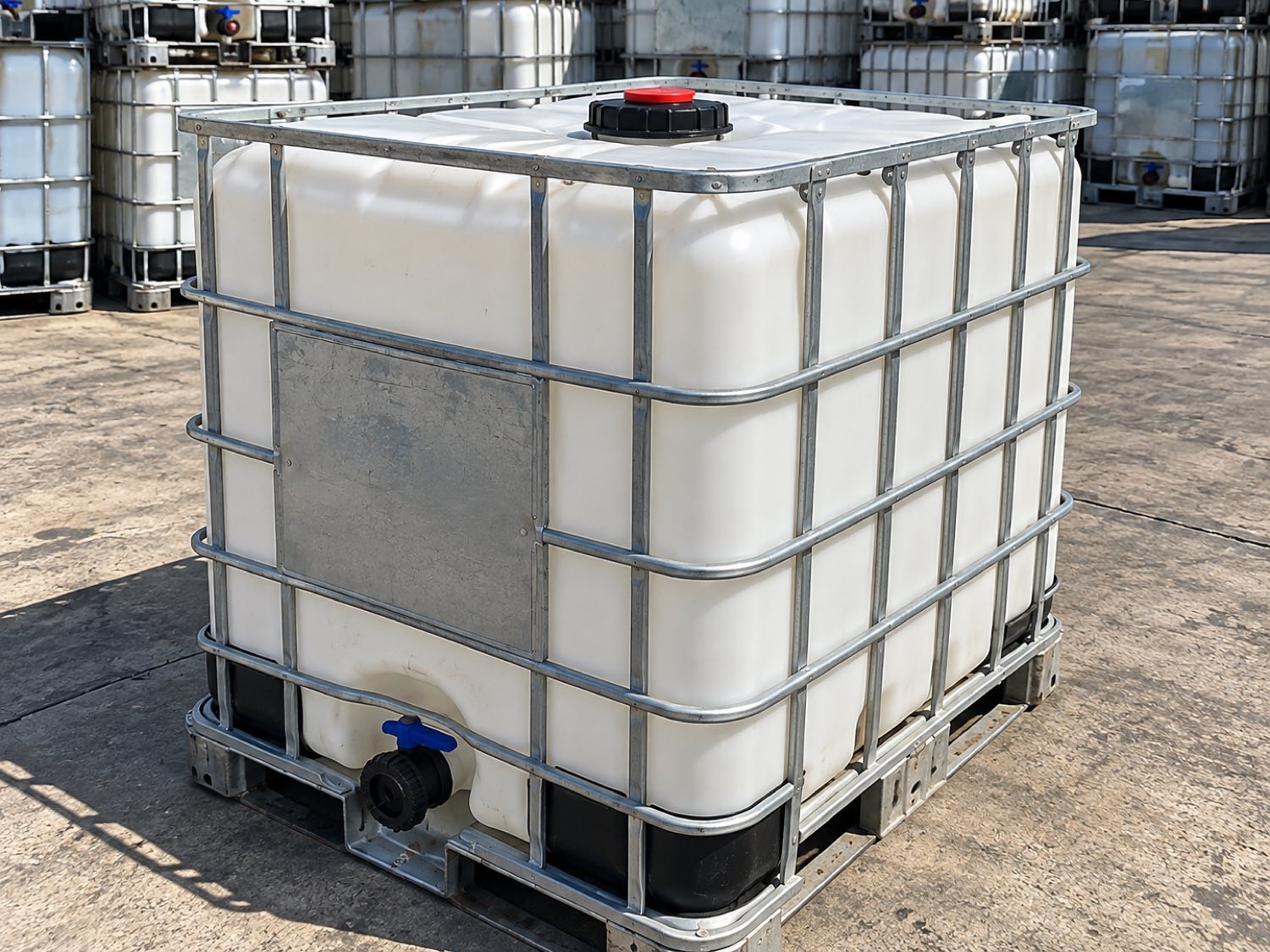
Reuse first, then recycle.