Product types
Every kind of IBC tote, from most-reused to brand new
Eight product families, one rule of thumb: pick the most-reused unit that will still do your job safely. New totes make sense for some jobs, but they are rarely the only option.
Request a quote, a grade or a pickup
One form for buying, selling, washing, shipping and recycling. A partner supplier in our network follows up.
The whole catalogue on one line each
| Family | What it is | Typical use |
|---|---|---|
| Used, Grade A washed | Washed, valve serviced, leak-checked | Industrial chemistry, coolants, detergents |
| Used, Grade B | Triple-rinsed, cosmetic marks | Site water, fertiliser, shop use |
| Used, Grade C | As-is, watertight but rough | Rain capture, ballast, non-critical storage |
| Rebottled | New bottle, reconditioned cage and pallet | Food, beverage, cosmetics, potable water |
| New | First-fill, factory UN plate | Regulated first-fill, matched sets |
| Stainless steel | 304 or 316L, CIP-ready | Spirits, pharma, hot fills, long service life |
| Accessories | Valves, camlocks, lids, gaskets, heaters | Keeping existing totes in service |
| Rainwater kits | Rain-grade totes with diverters and fittings | Rain capture, irrigation |
| Replacement parts | Cages, pallets, bottles, hardware | Repairing a damaged tote |
Pricing is by quote from partner suppliers and moves with resin, scrap and freight markets. Food-grade used totes can be requested on the quote form; see food-grade vs technical grade for what the term means.
Start where your liquid puts you
Pick by what is going inside, not by what looks tidiest on the trailer.
- 01
Used IBC totes
Grade A, B and C caged poly totes in 275 and 330 gallon, washed or as-is, supplied by partner suppliers.
OPEN → - 02
Rebottled IBC totes
A brand-new bottle inside a cage and pallet that already exist. A new food-contact surface without new steel.
OPEN → - 03
New IBC totes
Factory-fresh 31HA1 units when first-fill traceability is non-negotiable.
OPEN → - 04
Stainless steel IBCs
304 and 316L tanks, CIP spray balls, tri-clamp ports, built for decades of reuse.
OPEN → - 05
Accessories & fittings
The parts that keep a tote in service: valves, gaskets, camlocks, lids, band heaters, stands and dispensing kits.
OPEN → - 06
Rainwater harvesting kits
Rain-grade totes with first-flush diverters, screens, overflow and multi-tank manifolds, supplied by partners.
OPEN → - 07
Replacement parts
Cages, pallets, bottles and hardware sold separately so one damaged component never retires a whole tote.
OPEN → - 08
Food-grade vs technical
What "food grade" means on a used tote, and what documentation to ask the supplier for.
OPEN →
How to work out what you need
Start with the liquid. Specific gravity sets the gross weight and therefore the pallet and rack question. Chemistry sets the gasket: EPDM for water and caustics, Viton for solvents and acids, Buna-N for oils. Regulatory status decides whether you need a live UN marking or whether a de-certified unit is fine.
Only then choose a grade. Many jobs that start with a request for new totes are well served by reconditioned ones, because the job never needed a first-fill bottle. Reusing a tote avoids manufacturing a new one, and it is usually the lower-cost line on the quote.
Three combinations to avoid
A food-grade claim on a bottle that held a solvent, a de-certified tote used for regulated transport, and a wooden pallet in a clean or wash-down area. Ask the supplier about all three before you buy.
What to ask the supplier for with any unit
- A written grade, not a vague adjective, and photographs of the actual units.
- Last-known content on paper for any tote that held anything other than water.
- Confirmation the bottle has been leak-checked before it ships.
- Cap, gasket and dust plug fitted: you should never receive an open tote.
- A freight quote that matches the real trailer, including liftgate and dock-free options.
- Whether the supplier will buy the unit back or collect it when you are finished with it.
Questions people actually ask
Can I buy single totes or only pallets and truckloads?
Many partner suppliers handle single units as well as larger orders. Freight becomes a bigger share of the total on small orders, so it is worth comparing a single-unit quote with a partial load. Pricing is by quote from partner suppliers.
Can I see the totes before buying?
Ask the partner supplier when they follow up. Many can send photographs of the exact lot, including cage plates and bottle interiors, and some offer local pickup and inspection.
What is the difference between a caged IBC tote and an IBC tank?
In everyday use they are the same thing: a 275 or 330 gallon HDPE bottle inside a welded steel cage on a pallet. "IBC tank" is also used for stainless and composite variants. See stainless steel IBCs.
Do used totes still have their UN marking?
The plate is usually still attached, but a used tote is generally only suitable for regulated transport if it is inside its test window and has been retested. Read UN / DOT regulations, check current regulations and confirm documentation with the supplier.
Total cost of ownership: the lines to compare
One tote, one duty, several years. Purchase price is only one line; ask partner suppliers to quote the others too.
| Line | New | Rebottled | Grade A used | Grade B used |
|---|---|---|---|---|
| Purchase | Highest | Middle | Lower | Lowest |
| Inbound freight | Same | Same | Same | Same |
| Washing between fills | Same | Same | Same | Lighter duty |
| Valve and gasket service | Low | Low | Low | Higher |
| Cage or pallet repair | Low | Low | Moderate | Higher |
| Downtime / substitution risk | Lowest | Lowest | Low | Higher |
| End-of-life value | Buyback or collection, by quote | Buyback or collection, by quote | Buyback or collection, by quote | Lower |
The cheapest option on paper is not always the cheapest per fill once substitution risk is counted. Grade A washed is often the sweet spot for repeat duty, and rebottled is a common choice once food contact enters the picture. Pricing is by quote from partner suppliers.
A short technical glossary, because half of this trade is jargon
This trade has an unusually confusing set of near-synonyms. Here is what each term usually means.
Bottle
The inner HDPE receptacle. Also called the liner or, wrongly, the bladder: a bladder is a flexible liner in a different class of container. It is the only part that touches your product.
Cage
The welded steel outer. Sometimes "frame", occasionally "basket". It makes up most of the empty weight, and it is often retired for cosmetic reasons long before it is worn out.
Boss
The thickened area of the bottle around the discharge outlet. A common place for cracking, which is why inspection should start at the bottom rather than the top.
Heel
Residual liquid left in a container after it has been drained through the valve. The outlet sits above the lowest point of the bottle, so some heel is structural, not carelessness.
Reconditioned
Cleaned and returned to service with the original bottle. Commercially it means whatever the seller says it means, which is why written grade criteria matter. See grades explained.
Rebottled
A new bottle fitted into an existing cage. Any UN marking on the cage generally no longer describes the assembly.
De-certified
A unit whose UN marking has lapsed or no longer applies. Still usable for storage, internal transfer and non-regulated liquids, which covers most liquids.
Food grade
Food-contact resin plus a documented edible-only content history plus verified cleaning. Buyers can request food-grade totes; confirm the documentation with the supplier. See food-grade vs technical grade.
Tare
Empty weight. Roughly 125–140 lb for a 275 gallon unit depending on pallet type. Add it to your liquid weight before you check a rack rating.
Gross
Total filled weight. Gallons × 8.345 × specific gravity + tare. The number that decides whether your floor, your jack and your racking are adequate.
How to read any tote supplier’s offer
Signals worth looking for, and warning signs, whichever supplier quotes you.
Good signs
- +Written grading criteria you can hold them to, with named failure conditions.
- +A stated position on undocumented prior contents, and a willingness to refuse a sale.
- +Leak-test and wash records available per unit, not per delivery.
- +Quotes that name the variables: grade, quantity, freight.
- +An offer to buy back or collect units at end of life.
- +A clear statement of what they will not supply.
Warning signs
- −"Food grade" used without any reference to content history.
- −Stock photographs of pristine totes and no photographs of actual inventory.
- −A single price for "used IBC tote" with no grade attached.
- −No mention of leak testing anywhere.
- −Vague answers about what was in the units previously.
- −Prices that undercut the scrap value of the steel, which suggests something is being skipped.
Long-tail questions about buying totes
Can I mix grades in one order?
Usually, yes. A common split is a few Grade A units for product that matters, Grade B for utility duty, and Grade C for site water. Buying by duty rather than buying everything to the strictest specification is one of the largest savings available to most buyers.
Can totes ship outside the United States?
This service handles requests from across the United States. Overseas shipment rarely makes sense for empty totes; a supplier in your own region is usually the better route.
Is there a minimum order?
It depends on the partner supplier. Freight economics mean small deliveries cost more per unit, and the cost per unit generally improves as quantity rises. Local pickup can make single units practical.
Can I get totes in a specific colour?
Natural translucent and black are the two realistic options in poly. Black is worth it outdoors because it blocks UV and slows algae, and natural is useful indoors because you can see the level through the wall. Anything else is a custom moulding run.
Can resellers request tote lots?
Yes. Describe the quantity and grades on the quote form and a partner supplier follows up.
How quickly can a large order be filled?
It depends on grade and supplier. Documented food-history units are usually the slowest, because the constraint is documentation rather than containers. Rebottled units are often the faster route to a large order with a never-filled interior. The partner supplier confirms timing.
What if I order the wrong thing?
Tell the supplier before you fill it. Returns, restocking and buyback are set by the partner supplier’s own terms. See terms.
Is anything other than IBCs available?
Some partner suppliers also handle poly drums and stainless drums. This site focuses on IBC totes, their parts and accessories.
Not sure which family fits? Describe the liquid.
Product, specific gravity, temperature, food contact and quantity. That is enough for a partner supplier to suggest the lowest grade that is safe for the job.
How the IBC tote became the default container
A broad-brush history, because knowing why the thing is shaped like that explains most of its quirks.
- 1960s
Steel drums own bulk liquid
The 55-gallon drum is the unit of industrial liquid. Handling is manual, and a plant using a lot of liquid handles a very large number of containers.
- 1970s
Rigid plastic arrives
HDPE blow moulding matures and rigid plastic intermediate bulk containers begin to appear. They hold more than a drum and weigh less than steel.
- 1980s
The composite design settles
The familiar formula takes hold: a blow-moulded HDPE bottle inside a welded steel cage on a pallet. The cage solves the structural problem, the bottle the chemical one, and the pallet lets it move through existing buildings.
- 1990s
The footprint standardises
Manufacturers converge on the 48 × 40 inch pallet footprint in North America and 1,200 × 1,000 mm in Europe, so racking, trailers and dock equipment work without modification.
- 1990s
UN classification formalises
Designations such as 31HA1 and the periodic testing regime bring IBCs into the dangerous goods framework.
- 2000s
Reconditioning grows
Enough totes are in circulation that washing and reselling becomes an industry. Grading standards vary by supplier, which is still true today.
- 2010s
Rebottling spreads
Because the cage usually outlives the bottle, replacing the bottle becomes a product rather than a repair.
- 2020s
Packaging reuse gets attention
Supply-chain reporting brings industrial packaging into view, and reuse becomes part of the conversation.
Manufacturer guide: who builds what, and what it means for you
A few names cover much of the North American supply. Their differences are small until you need a part.
| Maker | Typical outlet | Notes for buyers |
|---|---|---|
| Schütz | 2 in NPS | Very common; parts widely available |
| Mauser | 2 in NPS | Not bottle-compatible with Schütz cages |
| Greif | 2 in NPS | Check overall height against your space |
| Werit | 2 in BSP common | European thread; label these in a mixed set |
| Other builders | Varies | Check the plate before ordering parts |
| Rebottled units | As specified | Bottle date will not match the cage plate |
None of this matters until you order a bottle, a top rail or a cage. Then it matters completely, so record the plate details before requesting parts. Confirm specifics with the supplier.
Twelve things to ask before your first tote order
The questions that prevent most post-delivery surprises.
- "Will it fit through the door?" Measure the clear opening, not the frame. Lead with the 40 inch dimension.
- "What does it weigh full?" Gallons × 8.345 × specific gravity + tare. Check it against your jack and your floor.
- "Do I need a liftgate?" If you have no dock and no forklift, yes, and it is better booked than discovered.
- "Is the valve the right thread?" 2 in NPS is common in North America, BSP on many European builds.
- "Do I need a vented lid?" If you gravity-discharge at all, yes.
- "What gasket is fitted?" EPDM, Viton or Buna-N, chosen for the product going in.
- "What was in it before?" It should be in writing before the tote arrives, not after.
- "Can I stack these?" Follow the plate rating, and never with a bent cage.
- "Where do I put it?" Level, load-bearing, shaded, with valve access and jack clearance.
- "What happens in winter?" Drain down, valve open, or jacket it.
- "What do I do with it afterwards?" Ask about buyback or collection at the time of purchase.
- "Who handles problems?" Confirm the partner supplier’s contact route and terms with the quote.
What used IBC totes look like
Typical reconditioned and used totes in storage.
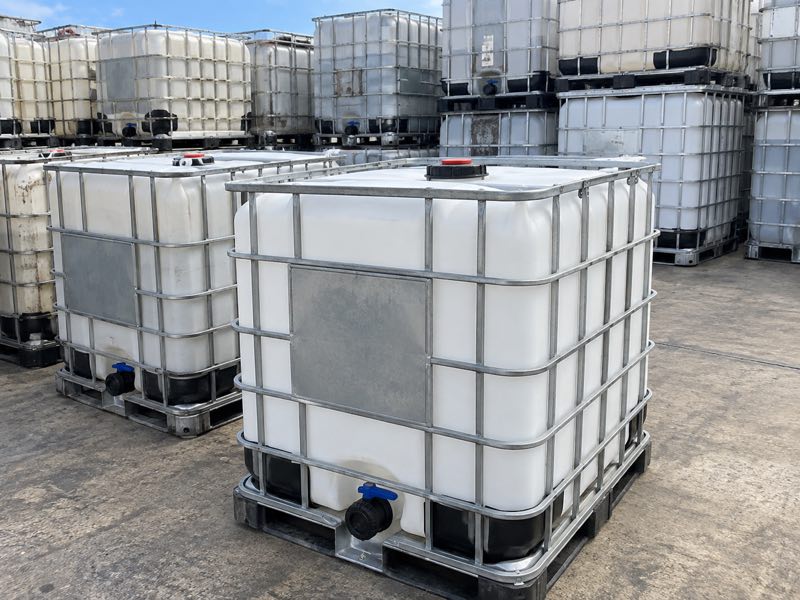
Washed 275 gallon totes. Look for a bright bottle wall, a sound cage, and a valve and cap fitted on every unit. 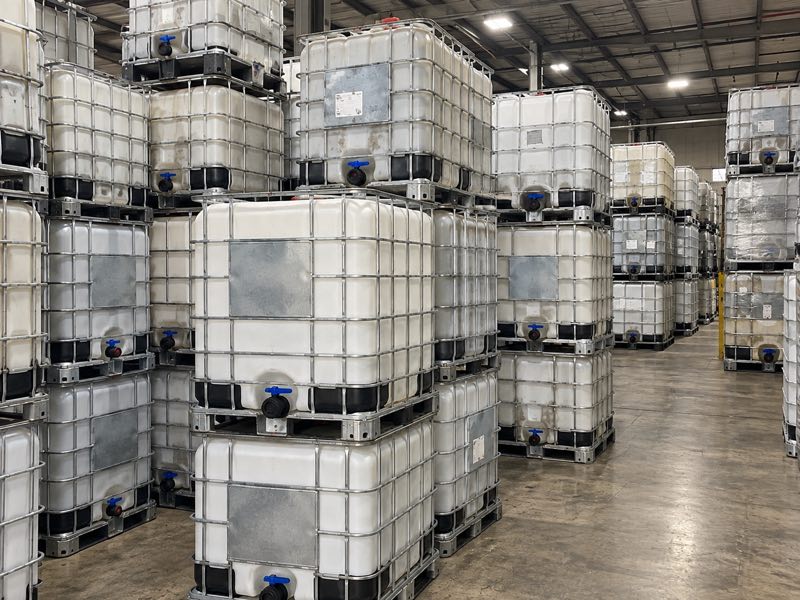
Covered storage. Sunlight degrades HDPE bottles over time, so indoor storage helps protect them. 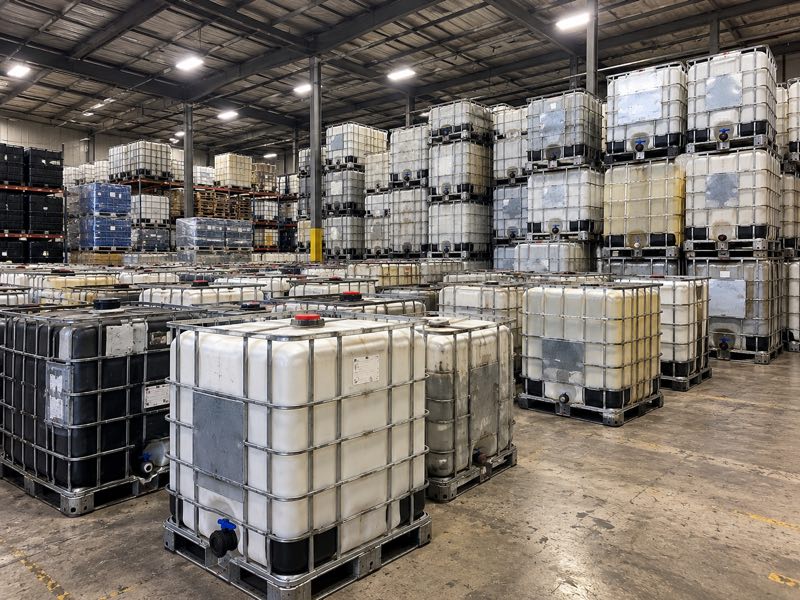
Totes with natural and black bottles side by side. Black bottles are used where UV exposure or light-sensitive products matter.
Reuse first, then recycle.