Industries
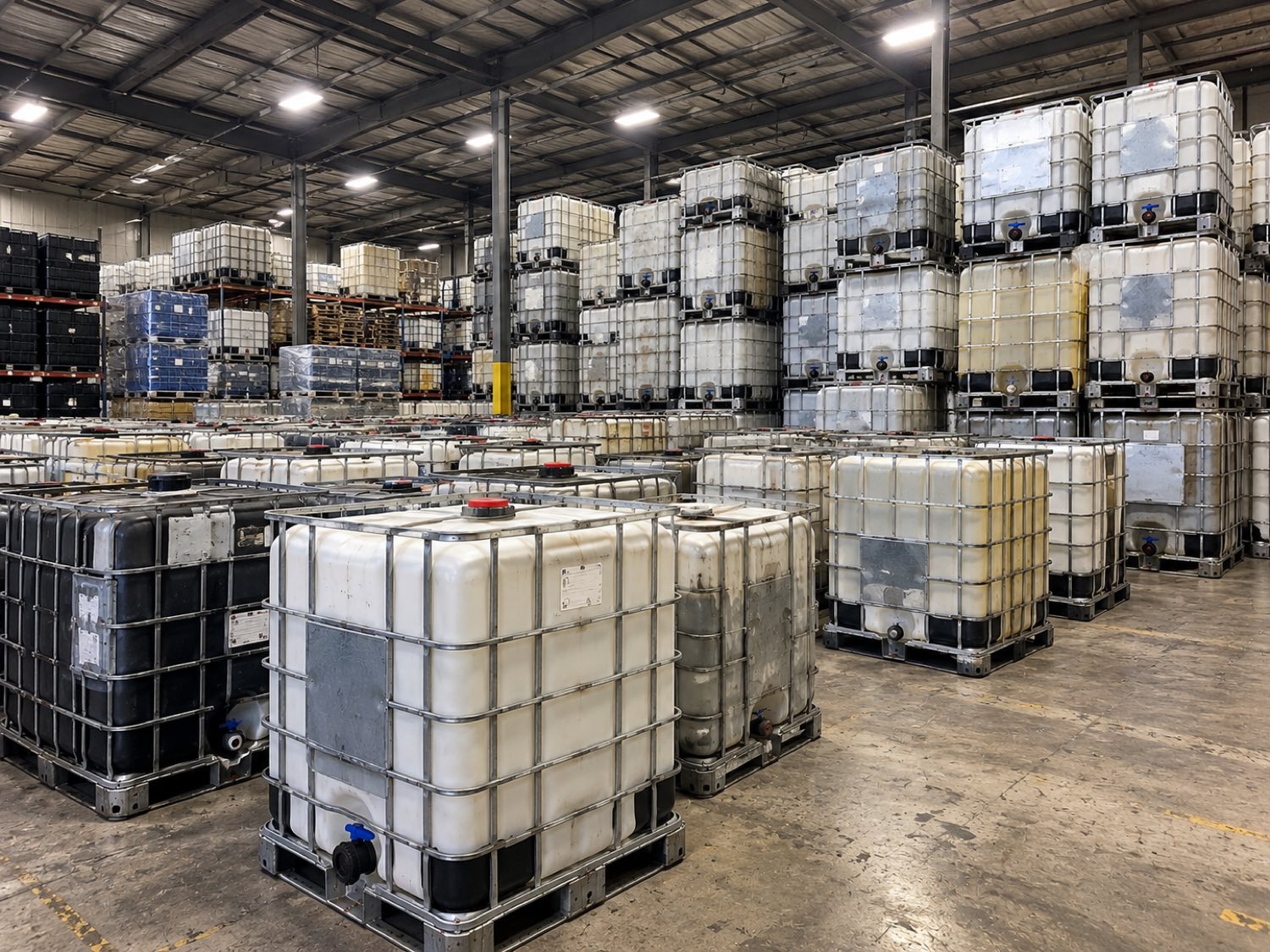
The same steel box, five completely different specifications
A tote for a chlorine dosing skid and a tote for a maple syrup line look identical on the trailer and have almost nothing else in common. Pick your industry to see how totes are typically used there and what to ask a supplier before you buy.
Request a quote, a grade or a pickup
One form for buying, selling, washing, shipping and recycling. A partner supplier in our network follows up.
Specification matrix by sector
| Sector | Grade | Gasket | Pallet | Paperwork to ask for |
|---|---|---|---|---|
| Chemical processing | Grade A washed, documented | Viton or EPDM to chemistry | Composite or steel | Prior content; UN marking if regulated |
| Food & beverage | Rebottled or food-history | EPDM / silicone | Plastic | Content history, cleaning record |
| Agriculture | Grade B / rain grade | EPDM | Composite or steel | Prior content |
| Water treatment | Grade A washed | Viton for hypochlorite | Steel, outdoor | Prior content, test record |
| Breweries & distilleries | Food-history, rebottled or stainless | Silicone or EPDM | Plastic | Content history, cleaning record |
These are typical starting points, not a statement of suitability. Confirm documentation with the supplier and check the regulations that apply to your product.
Choose your sector
- CH
Chemical processing
Compatibility, prior-content discipline, UN markings and a route for heels at end of life.
OPEN → - FB
Food & beverage
Rebottled units, documented histories, odour checks and why plastic pallets are preferred.
OPEN → - AG
Agriculture & growers
Irrigation banks, fertiliser handling, rain capture, gravity manifolds and winterising.
OPEN → - WT
Water treatment
Hypochlorite, polymer and coagulant duty with the right elastomers and containment.
OPEN → - BD
Breweries & distilleries
Wort, spirits, glycol, spent grain and where stainless makes more sense than poly.
OPEN →
Not on the list? Describe the job.
Totes are also common in construction and remediation, events, aquaculture and municipal work. Tell us the liquid and the duty in a free, no-obligation quote request and a partner supplier in our network follows up.
Three specification mistakes that cross every sector
Specifying the whole order to the strictest duty in it
A brewery that needs a handful of totes for wort and many more for glycol, cleaning chemistry and spent grain does not need food-contact units for all of them. Splitting the specification by duty is the simplest way to avoid paying for capability you will not use.
Buying a UN marking that will never be used
UN marking governs the transport of regulated dangerous goods. If your material has no UN number and no hazard class, a current marking may add nothing for your use. Check your classification and current regulations before paying for one — see IBC tote regulations.
Writing a specification around a product rather than a requirement
Institutional specifications often describe a new container simply because that is what someone was looking at when the document was written. Rewriting it around the requirement — capacity, compatibility, containment, marking status — lets reconditioned units compete on equal terms.
Cross-sector questions
We are in a sector you do not list. Can you still help?
Very likely. Totes are also used in remediation, events, aquaculture, education and municipal work. Describe the liquid and the duty in a quote request and a partner supplier in our network follows up.
Do different sectors get different pricing?
Pricing is by quote from partner suppliers and generally follows grade, quantity and freight rather than the buyer’s industry.
Can a supplier work with public-sector purchasing rules?
Many partner suppliers are used to purchase orders and formal quotes. Mention any framework or paperwork requirements in your request so the right supplier can respond.
Regulatory touchpoints by sector
Frameworks that commonly reach the container in each industry. A starting point only — check current regulations for your product and location.
| Sector | Frameworks commonly involved | Practical effect |
|---|---|---|
| Chemical processing | DOT hazardous materials rules, OSHA, state and local containment rules | UN marking if regulated in transport; containment |
| Food & beverage | FDA food-contact rules, audit schemes (BRCGS, SQF, FSSC 22000) | History, cleaning records, plastic pallets |
| Agriculture | Pesticide label requirements, state rules | Pesticide-history exclusion |
| Water treatment | Drinking-water and chemical-handling rules, state and local containment rules | Compatible seals, containment |
| Brewing & distilling | TTB and FDA requirements | Food contact, traceable transfers |
| Construction | Site and stormwater rules | Usually few container-specific rules |
| Municipal | Procurement rules | Write the spec around requirements |
Rules change and vary by state. Confirm the requirements that apply to you, and confirm documentation with the supplier.
The one paragraph each sector should read
Chemical processing — your gasket can matter as much as your grade. EPDM in hydrocarbon service is a classic cause of valve weeps. Choose the elastomer from the safety data sheet.
Food and beverage — your documentation matters as much as your cleaning. An auditor is more likely to accept a used container with a traceable history than a spotless one without. Ask for unit-level records rather than batch-level.
Agriculture — your prior content matters more than everything else combined. A pesticide-history tote should never irrigate edible crops, however it looks or however often it has been rinsed.
Water treatment — your venting matters more than you expect. Hypochlorite, bisulphite and peroxide all degas, and a sealed tote of degassing product bulges and then weeps at the lid.
Brewing and distilling — your material matters more than your budget. Glycol, caustic and spent grain suit poly; high-proof spirits, terpenes and hot fill suit stainless.
Construction and remediation — Grade C units are often all the job needs. Match the grade to the duty and avoid paying for capability you will not use.
One container, many specifications
Where people go from here
Reuse first, then recycle.